On 2026-11-02 we ran our homepage check on the websites of 8 auto body shops in Honolulu, found through a Google Maps search: open businesses with a website, five or more reviews, and a rating of 3.5 or better. Six of the eight sites loaded. Two refused the automated check, so every count below is of the 6 that did.
The check reads what Google reads: the title tag, the description, the main heading, images and their alt text, business markup, the sitemap, analytics, and Google's PageSpeed test for phones. No business is named. "One site" or "a company we checked" is as specific as it gets.
What the counts show
| Check | Result |
|---|---|
| No description | 6 of 6 |
| No Google Analytics | 5 of 6 |
| Main heading missing, or more than one | 5 of 6 |
| At least one image with no alt text | 5 of 6 |
| Old year in footer | 5 of 6 |
| Title tag over 60 characters | 2 of 6 |
| No business markup | 2 of 6 |
| No sitemap | 2 of 6 |
| Speed score under 50 | 1 of 6 |
Two lines in that table are unusual. Not one of the six sites has a description, the first time a whole trade has come up empty on that check in Honolulu. And five of the six count nothing: no Google Analytics, no Tag Manager, no record of what the website produced.
Not one site has a description
The description is the text a site suggests for the lines under its blue headline in a Google result. When a page has none, Google picks text from the page instead, and what a searcher reads is whatever Google grabbed: a menu item, an address fragment, half a sentence about towing.
For a body shop this is a real cost. The person searching just had an accident and is comparing three results on a phone. Two or three plain lines about what the shop does and where it is beat a random scrape of the page every time.
The result preview tool shows how any page's title and description look in a result, including where Google cuts them off.
Titles mostly fit, with two that run long
Every one of the six sites has a title tag, the blue headline itself. Google cuts a title at about 60 characters, and two of the six run longer than that. The longest is 100 characters, so a searcher sees barely more than half of it.
The shortest title on these sites is 22 characters. Short is not a problem the way long is, but a title that fits and says the trade and the place is the one line every shop controls completely.
Five of six get the main heading wrong
The H1 is the one heading that tells Google what a page is about. Two of the six sites have none, so the homepage never states what the business is. Three have more than one, which leaves Google to pick among competing answers. Exactly one site has exactly one.
Business markup is structured data that states the business type, address, and hours in a format Google reads directly instead of inferring. Two of the six sites have none. A body shop lives on searches from people nearby, and markup is the plainest way to state where the shop is and when it is open.
The before and after photos Google cannot see
The six homepages carry 92 images between them. Fifty-eight have no alt text. That is 63 percent of everything these shops show.
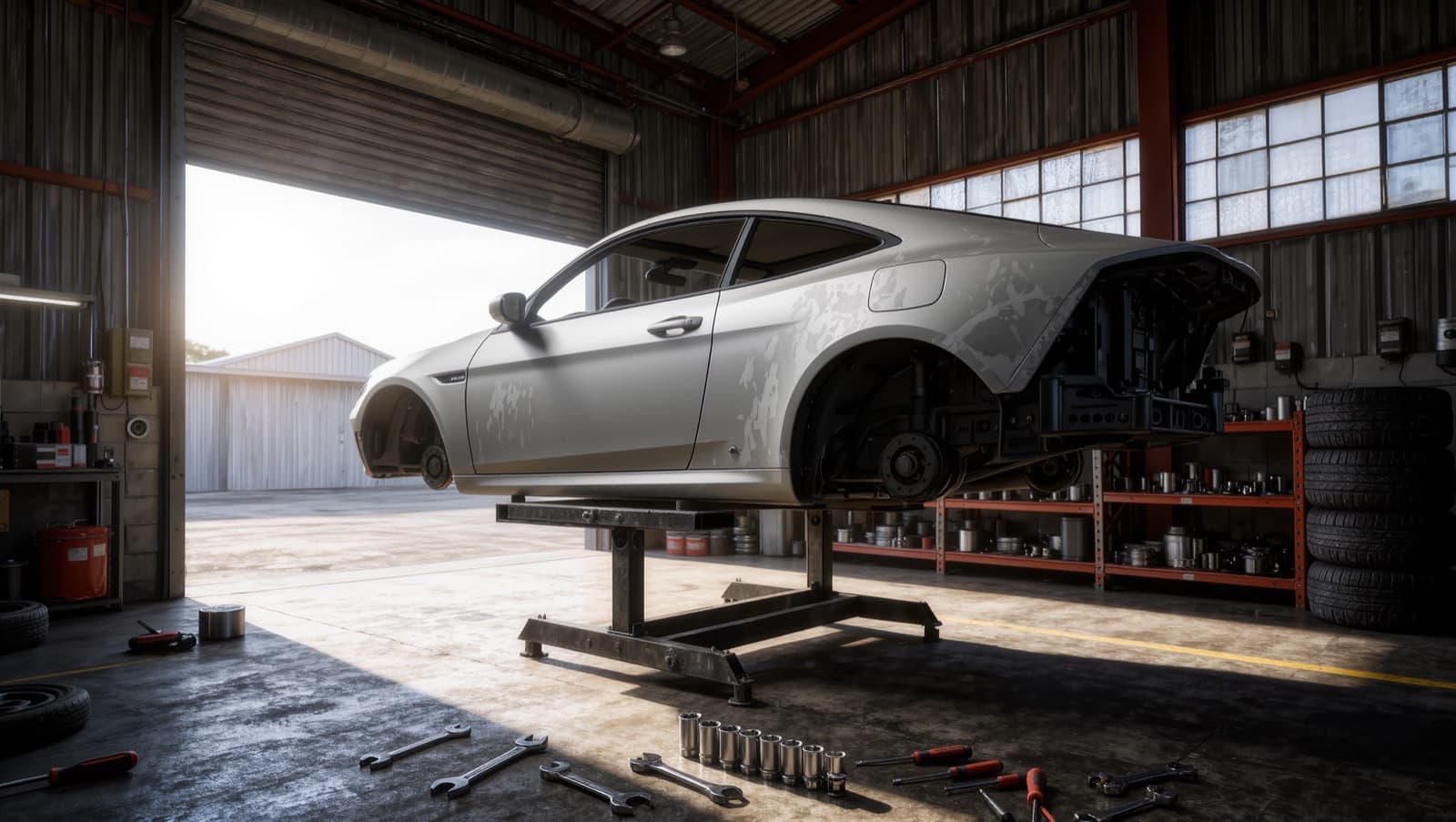
Alt text is the caption Google reads in place of a photo, because Google cannot see the photo itself. Body work is a photo trade: the crumpled quarter panel, the finished repaint, the shop floor. On these sites, nearly two of every three of those photos do nothing in search.
Five of the six sites have at least one blank image. The worst case is nearly total: one site shows 31 images on its homepage and 30 of them say nothing. The image alt check lists which images on any homepage are blank, with no email or account needed.
Speed scores from 44 to 99
We ran Google's PageSpeed test for phones on all six sites. The scores, lowest to highest: 44, 50, 54, 64, 75, 99. The median is 64, and one site lands under 50, which Google's tool marks in red as poor.
The 99 is worth a sentence. One Honolulu body shop has a homepage that loads about as fast as a page can on a phone, so a fast site in this trade is clearly possible, and the gap between 99 and 44 is the gap a customer feels while standing next to a damaged car.
The same tool runs its own SEO check, and these six sites scored between 77 and 100 on it. One site scored a perfect 100 and still has no description, no analytics, and blank images, because that check does not look at any of those. A green score there is not the all-clear it appears to be.
Footers from 2017 and sitemaps from 2021
Five of the six footers show an old year: 2017, 2020, 2024, 2024, and 2025. A footer nine years behind is a small thing a visitor may never notice, and a plain signal that nobody has touched the site in a long time.
The sitemaps say the same. Two sites have none, the file that tells Google which pages exist. Of the four that do, the newest date in the file ranges from 2021-12-03 to 2026-08-29, and three of these sites have told Google about nothing new since last year or earlier.
Nobody is counting
Five of the six sites have no Google Analytics and no Tag Manager on the homepage. Nothing records how many people arrived, what search brought them, or whether the website produced a single estimate request. Every other fix on this list becomes guesswork without that count, and there is more on what the free version tells an owner in why your website needs Google Analytics.
Two of the six sites run on WordPress and two on Wix. Both builders make every fix above possible without a rebuild; the pattern here is not bad software but sites built once and left to sit.
What these add up to
A driver with a crumpled fender searches once, on a phone, and picks from what shows up. These six sites give Google no description to show, hide most of their photos from search, and in five cases will never know the customer came and went.
The free homepage check runs every check above on any site in about ten seconds. For the full picture, including the Google listing, reviews, speed, and competitors, the free audit covers all of it.